Oprah Winfrey on Mel Robbins: Finding Your Purpose Starts With Listening to Yourself


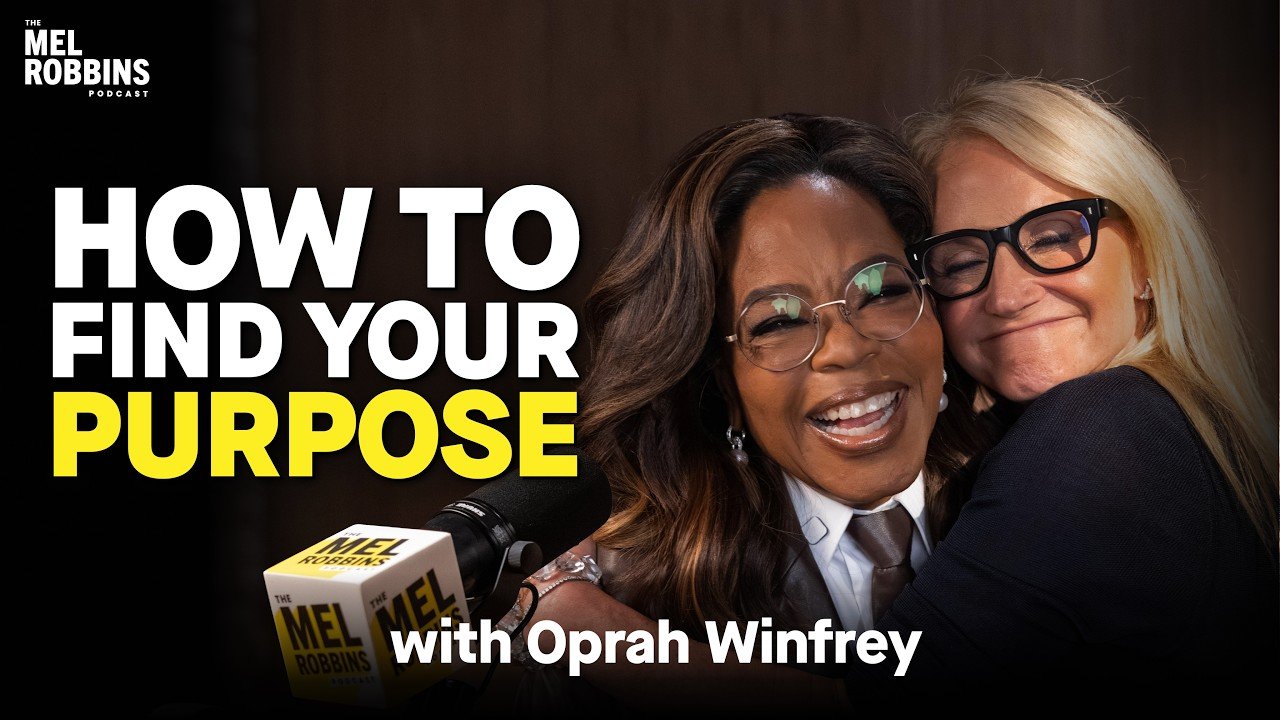
Oprah Winfrey joins The Mel Robbins Podcast for a conversation about trusting your inner voice, making peace with the past, and recognizing that a meaningful life does not have to be a public one.
For Oprah Winfrey, the most extraordinary part of her life is not what she has accumulated. It is who she has become.
That distinction anchors her conversation with Mel Robbins, which moves from childhood memories and painful family relationships to people-pleasing, the difficult early years of OWN, and the question of what it means to live with purpose.
Robbins approaches the interview as a longtime student, describing Winfrey as a teacher whose work helped her navigate fear, anxiety, and self-doubt. Winfrey returns that appreciation, telling Robbins that she sees her carrying forward a shared mission: helping people find their way back to themselves.
But the conversation’s central message reaches beyond either woman’s career. Winfrey argues that everyone has an inner source of guidance—and that the challenge is not acquiring it, but learning to listen.
What I have acquired is not as magnificent or extraordinary as who I have become.
— Oprah Winfrey
The Inner Voice Oprah Says Everyone Has
Winfrey describes her intuition as an “internal GPS.” In her view, it is not a special ability reserved for unusually successful people. What has made a difference in her life, she says, is her willingness to follow it.
Mine is no different than yours. The difference is I’m obedient to mine.
— Oprah Winfrey
She traces her earliest conscious memory of that guidance to childhood, when she lived with her grandmother in Mississippi.
While young Winfrey churned butter on the porch, her grandmother hung laundry outside. Her grandmother told her to watch carefully because one day she would need to know how to do the same work.
Winfrey remembers an immediate internal response: “No, you won’t. This will not be your life.”
She did not have a career plan or a clear picture of her future. What she had was a feeling that the life being presented to her was not the only possibility.
Robbins draws out a practical distinction: sometimes people cannot identify what they want, but they can recognize what they do not want. Winfrey agrees that this recognition can be useful information rather than something to dismiss.
The conversation frames self-trust as a process that may begin with a quiet refusal, not a fully formed answer.
Your Platform May Already Be in Front of You
Winfrey repeatedly challenges the idea that purpose must involve visibility, fame, or a dramatic achievement.
When Robbins raises the pressure to make a calling look impressive or “Instagrammable,” Winfrey redirects the discussion toward everyday relationships.
A family, a workplace, a community, or a circle of friends can all be platforms, she says. The question is how someone uses the influence they already have.
Your legacy isn’t the big big big picture. It’s what you’re doing today.
— Oprah Winfrey
That includes how people speak to someone working at a dry cleaner, how they treat a person parking their car, and how they behave toward those closest to them.
Winfrey calls the emotional impression people leave a “heart print,” a term she credits to the late young poet Mattie Stepanek. In this understanding, legacy is not only something assessed at the end of a life. It is being created in ordinary encounters.
Later, Robbins offers a definition that brings this theme into focus:
Purpose is not the thing that you do. Purpose is the thing that happens in others when you do the thing you do.
— Mel Robbins
The distinction shifts attention away from finding the perfect job title and toward understanding the effect someone has on other people.
Making Meaning From Pain Without Saying It Was Deserved
One of the interview’s most difficult passages concerns Winfrey’s belief that painful experiences can eventually become part of what a person offers others.
Speaking about childhood poverty, sexual abuse, and loneliness, she describes finding meaning in how those experiences shaped her capacity to recognize and respond to other people’s pain.
I was not seen so that I could see other people. All the things that I didn’t get, I now can give to other people.
— Oprah Winfrey
Robbins pushes back on a familiar phrase: that everything happens for a reason. She points out that cruel and unjust things happen to people who do not deserve them. The challenge, she suggests, is finding a reason to move forward afterward—not explaining away the harm.
Winfrey clarifies that her perspective does not mean a person caused what happened or that it should have happened.
Her account is personal: experiences of not feeling seen helped inform her desire to see others. Experiences of abuse became part of the understanding she brought to conversations with other survivors.
Our offerings come from every lesson we’ve ever learned.
— Oprah Winfrey
The distinction matters throughout this section. Winfrey is describing how she has interpreted her own life, rather than establishing that suffering is necessary or justified.
Making Peace With What a Parent Could Not Give
Winfrey also speaks candidly about growing up without feeling loved in the ways she needed.
She recalls finding validation through teachers, schoolwork, reading, and public speaking rather than at home. Years later, when her mother described their family as having little money but plenty of love, Winfrey remembers being startled by how differently they understood the same past.
Her eventual peace did not come from deciding that her unmet needs had been imaginary. It came from recognizing her mother’s limitations.
Winfrey recalls a lesson from T. D. Jakes about people seeking “10-gallon” love from someone with a “pint-sized” capacity. The metaphor helped her distinguish between what she needed and what another person could actually provide.
Her mother, she says, expressed care through cooking and providing. Looking back, Winfrey also recognized the exhaustion of domestic work and the energy her mother spent caring for other people’s families.
Acceptance meant acknowledging both realities: she had needed more, and her mother had not known how to give it.
Forgiveness is giving up the hope that the past could be any different.
— Oprah Winfrey
In Winfrey’s explanation, forgiveness is a release from continuing to bargain with what has already happened. It does not rewrite the past. It changes the relationship a person has with it.
The Television Moment That Changed Her Intentions
The conversation turns to a defining moment in Winfrey’s television career: an episode featuring a man, his wife, and his mistress.
During the broadcast, the man revealed that his mistress was pregnant. Winfrey remembers the wife’s humiliation and her own immediate conviction that she could not continue making that kind of television.
She says the moment stayed with her long afterward.
It also helped sharpen a question that would guide her work: what was the intention behind putting something on air?
Winfrey credits Gary Zukav’s The Seat of the Soul with influencing her thinking about intention. She describes asking producers to bring not just an episode idea, but the reason for doing it.
The goal became helping viewers see themselves more clearly, learn something, or experience an insight—not simply creating a confrontation people would watch.
That same principle changed how she understood people-pleasing. When she said yes to avoid disappointing someone, the other person heard agreement. They could not be expected to recognize the resentment or reluctance she kept hidden.
For Winfrey, becoming clearer about intention also meant becoming more honest about saying no.
They don’t recognize that behind it you really didn’t want to do it ’cause you said you wanted to. You said yes.
— Oprah Winfrey
The OWN Decision—and the Right to Change Your Mind
Winfrey does not present herself as someone who has followed her own advice without fail.
Discussing the difficult early period of OWN, she says she ignored an unusually strong internal warning against moving forward with the commitment.
She recalls waking in the night, struggling to breathe, and repeatedly thinking that she should not do it. Her counterargument was that she had already signed and given her word.
In conversation with Robbins, she identifies a deeper motive: she was worried about what the people on the other side would think if she changed her mind.
What she had framed as keeping a promise was also, she says, an attempt to please others.
You always have the right to change your mind.
— Oprah Winfrey
Robbins asks a question that reframes the conflict: to whom was Winfrey keeping her word—the outside world or herself?
Winfrey describes the resulting struggle as painful partly because she believed she had recognized the warning and proceeded anyway. The experience challenged the idea that understanding a lesson means never having to learn it again.
As she puts it, a missed lesson can return “wearing a different pair of pants.”
If you don’t get the lesson, it comes around wearing a different pair of pants.
— Oprah Winfrey
Looking Beyond the “Six-Tree Dream”
One of the interview’s most memorable stories begins with a modest image of success.
While working in Baltimore, Winfrey visited a producer’s home and admired the trees outside the window. She remembers counting six and deciding that, if she ever had money, she wanted trees of her own.
Years later, looking out of her kitchen window, she recognized a similar view. Then she stepped outside and realized that the six trees she could see were only a small part of the landscape around her.
She had imagined six trees. Her life had brought her a forest.
My dream was six trees. The life force that I call God had a bigger dream for me.
— Oprah Winfrey
Winfrey uses the story to explain her spiritual belief that life can hold possibilities beyond what a person currently knows how to imagine.
Throughout the conversation, she speaks of God, a life force, and a source greater than herself. She presents that connection as central to her own sense of direction, while emphasizing that people may use different names for it.
The forest becomes her metaphor for a larger life: not necessarily more possessions or recognition, but a wider understanding of what someone might contribute.
Gratitude and the Smallest Available Act of Service
When the discussion turns to where a person can begin, the answers become deliberately small.
Robbins describes greeting a downcast stranger early one morning and watching her expression change. The exchange did not solve either person’s problems, she acknowledges. It did demonstrate an immediate ability to affect someone else positively.
It doesn’t pay the bills, but it shifts something in you to know that you still have the power to positively impact somebody else.
— Mel Robbins
Winfrey connects that example to service: influence does not begin only after life becomes easy.
She also describes gratitude as a central personal practice. Her suggestion is to name five things to appreciate—or three, if five feels out of reach. If even that feels difficult, she suggests beginning with the fact of breathing.
You start looking at what you have instead of what you haven’t.
— Oprah Winfrey
Winfrey attributes shifts in her own outlook and life to that practice. Her explanation includes spiritual ideas about energy and attraction; within the conversation, these are beliefs she draws from her experience, not scientific findings.
The practical thread is noticing what is present rather than allowing what is missing to occupy the entire frame.
Finding the Thread That Runs Through Your Life
Rather than treating purpose as a hidden answer waiting somewhere in the future, Winfrey suggests looking backward for a recurring thread.
Wherever you are in the journey, you are already creating a thread of purpose that flows through everything that you’ve done.
— Oprah Winfrey
For her, that thread is inspiration through speaking: reciting in church as a child, entering oratory competitions, working in radio, moving into television, and eventually sitting across from Robbins.
The formats changed. The underlying contribution remained connected.
When Winfrey asks Robbins to name her own thread, Robbins answers: encouragement.
Robbins explains that people can possess useful information without believing it will work for them. Encouragement helps bridge that gap. Sometimes, she says, someone needs to borrow another person’s belief before they can act on their own behalf.
When you don’t believe in yourself, being able to borrow somebody else’s belief in your ability can really help.
— Mel Robbins
The exchange brings the interview’s two central ideas together: purpose may already be visible in a person’s history, and its meaning may be clearest in what others receive from it.
At 72, Oprah Is Thinking About What She Still Wants to Give
Near the end of the interview, Winfrey discusses her idea for an immersive experience at Sphere in Las Vegas.
She says the inspiration came while attending a U2 performance there in 2023. Looking at the venue, she imagined using its scale and technology to help people feel connected to themselves, to one another, and to something larger.
She describes it not simply as a show, but as an experience intended to be felt.
The project also leads to a more personal reflection on time. At 72, Winfrey says she is approaching her life with the awareness that she may have one solid decade left in which to offer her message with clarity, love, and less ego.
I have one solid decade left to give and offer the message that I came to give and to do it with clarity and do it with love and do it without ego.
— Oprah Winfrey
Robbins suggests that the same thought experiment could sharpen anyone’s priorities: what would change if you treated the next decade as your time to do what you came to do?
Winfrey’s answer remains grounded in both large ambitions and small encounters. Whatever project comes next, she says she also feels responsible for truly seeing the people she meets each day.
Her closing words turn the conversation from reflection toward action:
You were born to fulfill the dream of your life here on Earth.
— Oprah Winfrey
Then comes the instruction that gives the interview its final push:
Get about the business of doing that.
— Oprah Winfrey
This recap is based on Oprah Winfrey’s appearance on the Mel Robbins podcast. For the full episode, click on the YouTube link at the top or listen wherever you get your podcasts.