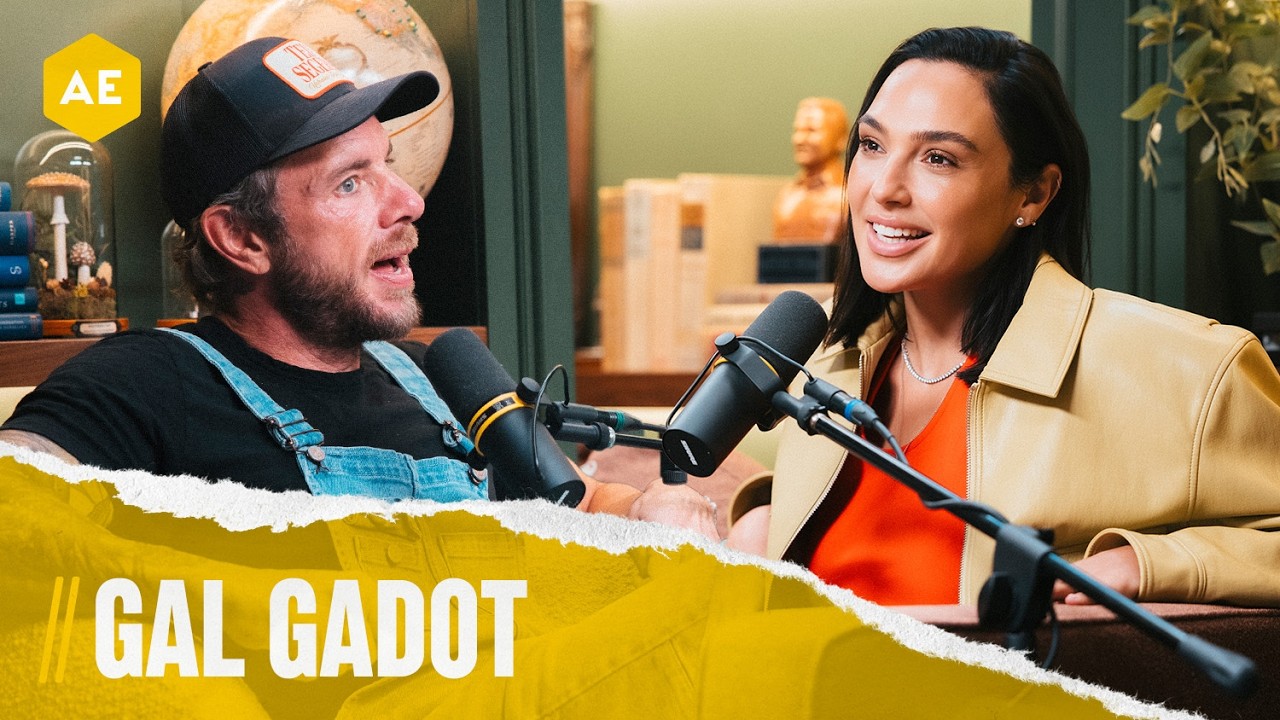
Gal Gadot on Her First-Ever Podcast: From the IDF to Hollywood, Pregnancy Complications, and “The Runner”


Dax Shepard and Monica Padman sit down with Gal Gadot to trace her unlikely path from Israeli dancer and soldier to global movie star, while digging into pain, ego, motherhood, and her new nonstop thriller, The Runner.
How the podcast started: “an arena to fight”
The hosts reveal the show began almost by accident: they were already arguing constantly in Kristen’s kitchen, turning everyday topics into hour-long debates. One host wanted a space where she could be her “full self” beyond 7‑minute talk-show segments, and the other became a natural banter partner.
We didn’t do it at all. You were just looking for an arena to fight kind of.
They’ve been recording for nearly nine years, often walking just feet from their houses to the same studio.
Astrology as icebreaker, not religion
Astrology comes up immediately (Double Taurus vs. Double Virgo) and becomes a recurring social shortcut with guests. Gal describes her conversion from skeptic to casual believer after a TV astrology reading accurately guessed she was newly pregnant at 25. Dax remains skeptical but acknowledges its social utility and the human desire to feel “seen.”
I like feeling known. People like feeling known and seen and they’re like, ‘Oh, that is me.’
“Chat, describe me in one word”
They test an AI trend: asking ChatGPT to describe each of them in one word in real time. Both Gal and Dax get “curious,” which they link to their interviewing style; other friends get “determined,” “caring,” “family oriented,” etc. There’s a funny bit where the AI clearly infers Dax’s identity and connections (Kristen, Armchair Expert, Monica Padman) even though she never explicitly told it.
I’m very curious. That’s why this show exists.
Peptides, GLP‑1, and women’s health
The conversation shifts into peptides: GLP‑1 drugs, Tesamorelin, off‑label use, and the difference between “peptides are dangerous” vs. “how people are getting peptides is dangerous.” Gal emphasizes medical supervision, regular blood panels, and cancer-risk screening when using anything that affects growth hormone.
This segues into a broader critique of how women’s health has been under-researched, with examples like Ambien’s stronger effect in women and the historical excuse that menstruation makes women “terrible research subjects.”
Are peptides dangerous or are how people are getting peptides dangerous? The latter.
Women were denied any help in that realm… there’s so many things that had never been fully deeply thoroughly explored.
A life-threatening pregnancy complication
Gal shares a harrowing story: cerebral venous thrombosis (clots in brain veins) during pregnancy, initially dismissed as migraines. After weeks of debilitating headaches and being largely bedridden, an MRI finally reveals the clots; she’s told most people with that blockage are in a coma. The baby is delivered first, then she undergoes a major endovascular procedure and goes on blood thinners.
Usually when they see this type of blockage people are in coma. I was supposed to be in coma.
If you’re a woman, you’re not going to take anything you say seriously. And then if you’re black, it’s like 3x the data of not being believed for your pain.
Childhood, engineers, and emotional dads
They touch on Gal’s engineer father (biomedical devices, satellites) and the stereotype of cerebral, disagreeable engineers—amplified by Israeli culture’s debate-heavy Shabbat tradition. Despite that, she describes her dad as a “softy” who, with age, has become more emotionally open and eager to talk about feelings.
Dax notes a common trajectory he sees: women cry more when younger and less later; many men do the opposite, opening up emotionally after careers peak and kids grow.
At some point… you start feeling that life is not here forever… what’s important is… what’s the most important thing?
Burger King, Miss Israel, and Miss Universe
Gal pushes back on the “I never wanted modeling” lore: she worked at Burger King after high school, wasn’t chasing modeling, but did agree to compete in Miss Israel 2004, partly to tell her grandkids one day that “grandma competed.” She won, received a Citroën, drove it for three months, then sold it and used the money to start investing.
At Miss Universe in Ecuador, she was fearful of winning again and admits she wasn’t fully invested; she describes the pageant ecosystem (poised South Americans, mellow Europeans, low-drama Asians) and casts herself as the “rebellion contestant.”
I was like a girl. I was a dancer, athletic, like an athlete… [pageants are] very subjective.
Military service, Maxim, and the accident that changed everything
After a three-month modeling stint in Milan at 18, Gal returned for mandatory IDF service, where she became a trainer and learned Krav Maga—emphasizing real-world combat and using your surroundings.
An IDF promotional Maxim spread then landed on the cover of the New York Post, sparking a controversy in Israel about using beauty pageant winners to promote tourism. Suddenly, the 21‑year‑old was fielding calls from the Israeli ambassador and interviews with CNN, Fox, and NBC, despite rough English at the time.
I wake up and the ambassador is calling me… ‘Go get the New York Post. You’re on the cover… CNN wants to interview you.’
She used the moment to push back on stereotypes about Israel (“We ride donkeys and we carry M4s”) and invite people to visit.
From Bond girl audition to Fast & Furious
A London casting director found Gal’s card, called her in for a Quantum of Solace Bond girl audition. She almost didn’t go, showed up late, and ended up giving the casting director her expensive La Mer lip balm when her lips were chapped. She didn’t get the Bond role, but years later that same casting director recommended her to Universal for Fast & Furious.
After a camera test in LA, she clicked with the team and landed the role that would launch her Hollywood career. She describes her parents’ pressure to get a “real job” (law, inspired by Ally McBeal) versus her husband’s “let’s enjoy the lighter side of life” stance, and her own Taurus need for stability clashing with acting’s uncertainty.
It’s a lot of traveling, a lot of uncertainty. Nothing is up to me. I’m not in control of anything. And it’s hard.
Fast 7 death, rejection, and nearly quitting
Gal played Gisele in Fast & Furious 4–6, then was told in Fast 7 that her character would die. She was bummed to leave the “community” of the franchise. Afterward, she spent years auditioning in LA with a toddler at home, facing constant rejection and considering quitting acting entirely—even thinking about going back to school or becoming a sculptor.
It’s too much rejection… Why am I doing this? I’ll go back to school or I’ll be a sculptor.
Wonder Woman: underdog hit and postpartum reality
She then auditioned for what turned out to be Batman v Superman, secretly testing for Wonder Woman. The role became her own film, made on a tight budget with constant script tweaks and two versions of scenes shot in one day. The movie opened huge ($103M weekend, ~$862M total), but Gal says she wasn’t “popping” with joy: she was eight weeks postpartum with her second child and dealing with a major back injury.
When the movie opened I was very happy and I felt satisfied with the success but I wasn’t happy.
She reflects on how success can feel overwhelming in the moment, processed only in retrospect, and warns against ego-driven interpretations of fame: the world is loving an image and a symbol, not “you” as a person.
It’s not me that they love… It’s like this image, this character, a female being a matriarch, which no one gets to see.
“The Runner”: 110 pages of sprinting
The episode closes with Gal’s new film, The Runner, in which she plays a lawyer and mother whose diabetic son is abducted; the kidnapper forces her to keep running through London while she tries to save him—no stopping, no cabs, no talking to anyone.
She read the script while still recovering from her CVT and months of migraines, immediately doubting anyone could physically make it through “110 pages of running.” Director Kevin Macdonald, who had a similar clot scare six weeks before her, pushed the production back 9–12 months so she could recover, then hired elite trainers (including a U.S. Olympic sprint coach) to prepare her.
I had weeks where I had like 150‑something‑thousand steps… I finished the film on crutches.
She sustained multiple injuries, including stress fractures, and was worked on by therapists like a boxer between takes, but saw the role as a gift: a forced return to sweat and movement after a near-fatal health crisis.
This is the universe giving me exactly what I need… A director that will understand what I’ve been through… Breaking sweat like there’s no tomorrow.
This recap is based on Gal Gadot’s appearance on the Armchair Expert with Dax Shepard podcast. For the full episode, click on the YouTube link at the top or listen wherever you get your podcasts.